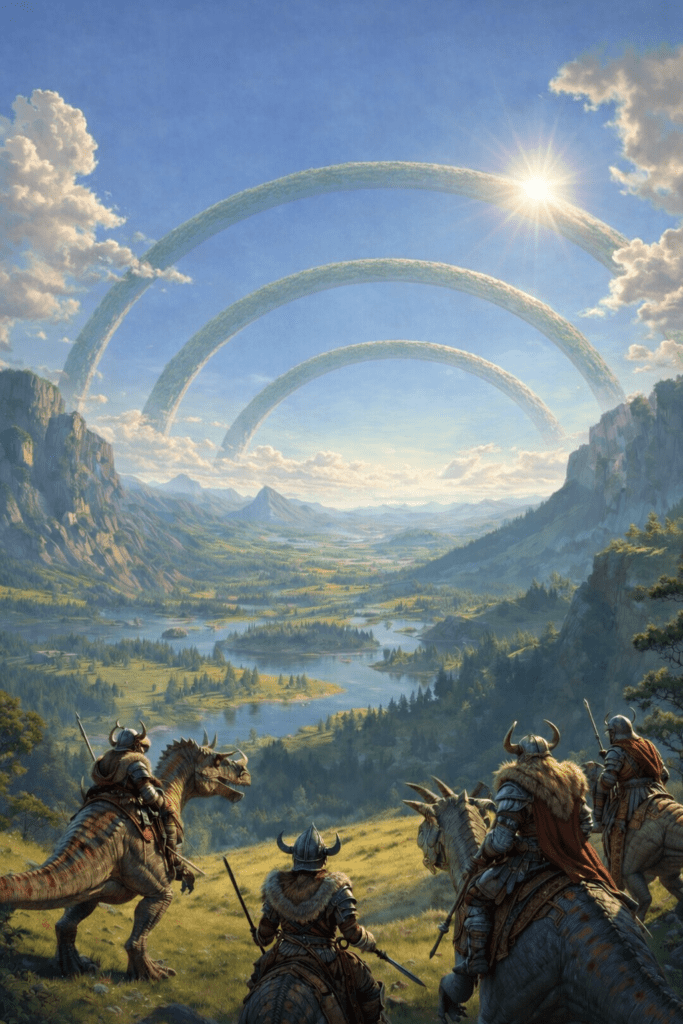
Vikings are cool. Dinosaurs are cool. Vikings & dinosaurs are awesome.
Pillage while riding a triceratops?
I have a setting concept for fiction and gaming. It is fantasy nestled within science fiction with vikings and dinosaurs as the core. Norse myth interpreted into a science fiction background paired with prehistoric-inspired monsters.
Complicated settings can kill immersion.
My fiction suffers from overcomplication. Stories require an audience. I have to simplify or fail to be read.
“Viking” evokes adventure in the junior high boy’s brain. In every healthy man, this main character syndrome lingers. This is why the “Hero’s Journey” has always and will always dominate stories for men.
Dinosaurs are a complete monster package. People understand and love them. No need to introduce a Tyrannosaurus Rex or a Triceratops. Maybe give them Viking names and a mutation to help with the cold, and they are ready for action.
Nine times nine rings spinning
For the physical setting, I draw on Halo and Ringworld. At the risk of alienation, I have to make it more complicated.
Each of the nine traditional Norse realms are divided into an inner bowl surrounded by eight spinning rings. Land dominates one side as water dominates the other.
It is a World Tree concept that is hard to describe even with AI’s help. What hope do I have with readers?
So far, I’ve never come close with AI to what I imagine in my head. I’ve even tried drawing and uploading, too even worse results.
Failing to prompt the Viking & Dinosaurs world…
The following is a prompt attempt made with help from another AI:
“A monolithic, aerofoil-profiled ring—600 miles of solid breadth surrounding a 1,200-mile central void—rotating with absolute gyroscopic stability around its central symmetry axis, its colossal mass gliding through the vacuum in a seamless, torque-free spin.”
I got this which is far from what I visualize:
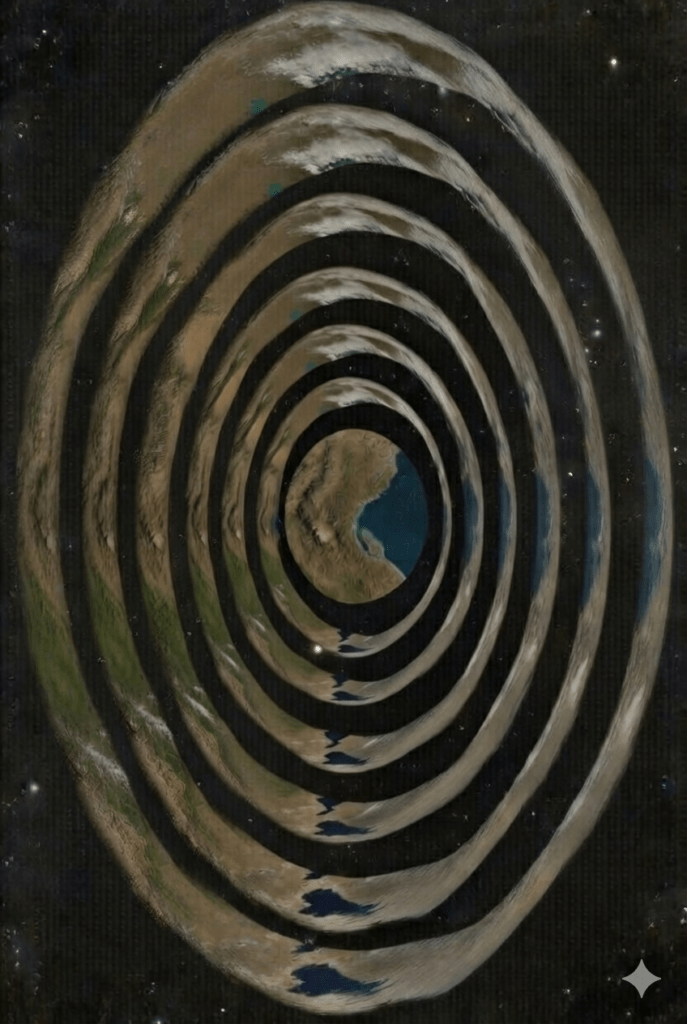
Incorrect ring number and relative width. Not spinning.
I also tried with:
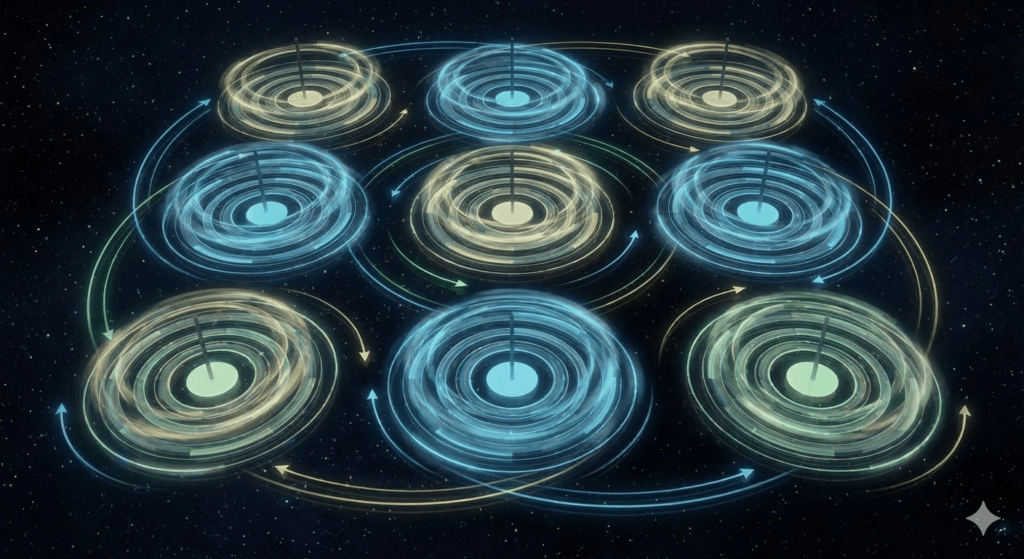
“A perfectly precise technical illustration of a 3×3 grid of identical rotational discs. Each disc contains nine concentric circular bands: one central circle and eight surrounding rings. All rings have equal radial thickness, and the central circle’s radius equals the ring thickness. Each ring is extremely thin, with a width-to-thickness ratio of 600:1. All circles and rings are perfectly concentric, perfectly circular, and evenly spaced. Each disc rotates around a shared invisible vertical axle. All nine discs rotate in the same direction. Within each disc, the outermost ring rotates fastest, and each ring inward rotates progressively slower, with the central circle rotating slowest. Show implied motion using subtle radial streaks or slight angular offsets, without distortion or heavy blur. Render the entire structure as a clean vector-style diagram with crisp lines, uniform stroke weight, and no texture. Use a neutral monochrome palette. Emphasize mathematical precision, symmetry, and perfect alignment across the 3×3 grid.”
Again. Failure to come close to the spinning wind ornament in my head.
“Precision Geometry Prompt (Structure First)A colossal monolithic megastructure floating in deep space. The structure is composed of exactly nine solid concentric components sharing a single central axis:1 central solid disk and 8 surrounding rings. The central disk is 1,200 miles in diameter and exactly 1 mile thick. Surrounding it are eight perfectly concentric rings. Each ring is exactly 600 miles wide (radially) and exactly 1 mile thick. There are NO gaps between rings. Each ring directly touches the next one. The structure forms a continuous stepped radial expansion outward. If each ring were filled into a solid disk, the diameters would be: 2,400 miles 3,600 miles 4,800 miles 6,000 miles 7,200 miles 8,400 miles 9,600 miles 10,800 miles (outermost boundary) The outermost diameter of the structure is exactly 10,800 miles. All components rotate in the same direction around the central axis. The central disk rotates at base speed. Each ring doubles the angular velocity of the previous layer: 2×, 4×, 8×, 16×, 32×, 64×, 128×, 256×. The different rotation speeds are visible through distinct motion blur levels for each ring. The structure is a seamless dark metallic monolith with sharp edges and precise geometry. Orthographic or slightly angled perspective to clearly show the full concentric structure. No Saturn-like thin rings. No gaps. No floating separated bands. Solid radial construction. The rings are thick solid bands like stacked architectural layers, not thin planetary rings.”
Nope. Third time, not a charm.
Prompt engineering is hard.
AI slop is often a copout label made by those ignorant of the difficulty in massaging what you want out of an AI.
Try it.
I’ve paused my attempts with this query, but I will return.
Viking dino world needs to spin.